
Read This If Your Dentures Still Smell After Soaking Overnight. The Odor Lives In A Film Inside The Acrylic (Soaking Tablets Are Not Reaching It)


You did everything the box told you to do.
You take your dentures out every night. You drop the tablet in the glass. You watch it fizz. You rinse them in the morning.
You brush them. Some of you brush them twice.
And by the middle of the afternoon the taste is back. A stale, sour taste on the plate. A smell you catch when you lift the denture out at night. You have started turning your head a little when you talk to people up close.
Maybe your gums are sore and red where the plate sits, too. Maybe your dentist looked and said "keep them clean".
You are keeping them clean.
That is not a failure of effort.
It is a failure of the method you were handed.
Because the smell on your dentures is not coming from the surface you rinse and brush. It is coming from a film that lives inside the acrylic, in pores too small to see. A fizzing tablet passes over the top of it every single night.
In 27 years as a dental hygienist I looked at that film under the light thousands of times. For the last several years I have also been carrying it around in my own mouth, on my own denture.
I will show you exactly what it is in a moment.
But first, there is something you need to stop doing tonight.
STOP SCRUBBING YOUR DENTURES WITH TOOTHPASTE

If you brush your dentures with regular toothpaste, I want you to do one thing before you read any further.
Stop.
Toothpaste is made for enamel, the hardest material in the human body. It contains fine abrasive particles that polish enamel.
Your denture is not enamel. The pink base and the teeth are acrylic, which is far softer. Those same particles cut fine scratches into it every time you brush.
You cannot see them one at a time. Hold the plate at an angle under the bathroom light and you will see what they add up to: a dull, hazy surface where it used to shine.
Every one of those scratches is a groove. And a groove is exactly where denture film settles in and holds on.
So the harder you scrub a set of dentures that cost you $1,800 or more, the more places you give the odor to live.
Nobody told you that when they handed you the dentures.
That changes right now.

My name is Linda Carroway, RDH. I worked as a dental hygienist for 27 years. I have cleaned thousands of dentures at the chair. And at 58 I was fitted with a full upper denture of my own, and found out what my patients had been trying to tell me.
THE MORNING MY OWN DENTURE SMELLED

I had been wearing my upper denture for about seven months.
I did it by the book, because I wrote the book. I had given the denture-care talk at the chair several times a week for most of my working life. Out at night. Tablet in the glass. Rinse in the morning.
One morning I lifted the plate out of the glass, and before I rinsed it I smelled it.
It had soaked for eight hours. It smelled sour.
Here is what embarrassed me most.
For 27 years, when a patient told me "my dentures smell even though I soak them", I had assumed, politely, that they were skipping nights. I gave them the talk again. I sent them home with a sample box of tablets.
And there I was, a hygienist who had not skipped one night, holding a denture that smelled.
That week my husband, without meaning anything by it, turned his cheek when I leaned in to kiss him goodbye.
That was the day I stopped assuming and started looking.
I took my denture into the practice, dried it, and put it under the operatory light with my loupes on, the way I would look at a patient's.
WHAT I SAW ON MY DENTURE UNDER THE LIGHT

The polished outside looked fine.
The inside, the surface that sits against the roof of the mouth and the gums, did not.
It had a dull, slightly cloudy coat. In the tiny pits of the acrylic and along the edges of the teeth there were pale tan deposits. When I ran an instrument across it, a soft layer came away.
I knew what it was. I had scraped it off other people's dentures for decades.
Denture film.
Dentists call it denture plaque or denture biofilm. It is a living layer of bacteria and yeast, bound together in a sticky coating they produce themselves, sitting on and in the denture.
It is not food debris. Food rinses off. This is stuck on, and it is what smells.
What I had never asked, in 27 years, was the obvious question. Why was it still there after eight hours in a cleanser?
THE REAL REASON YOUR DENTURES SMELL AFTER SOAKING
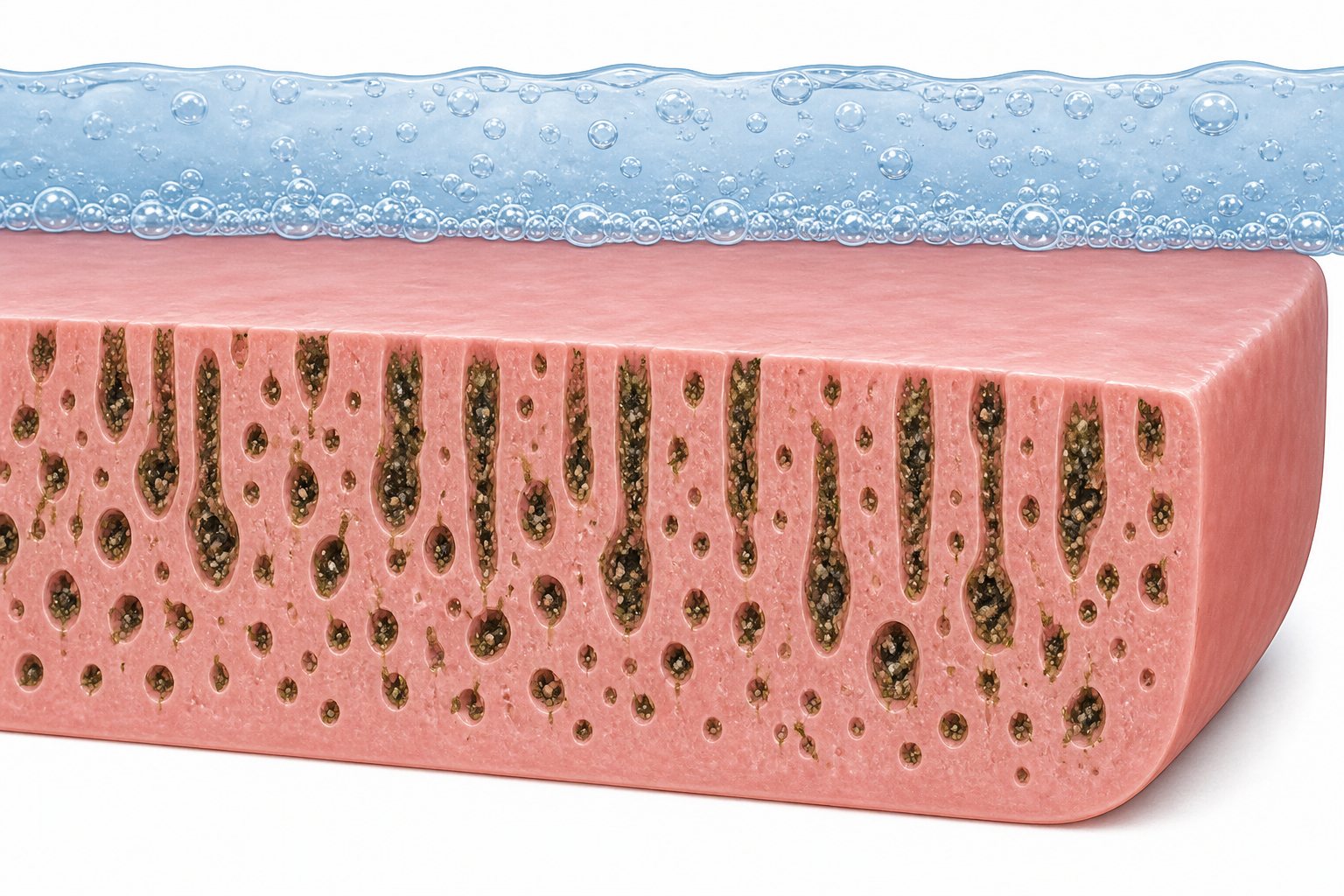
Denture acrylic is porous. It looks solid and smooth. Under magnification it is full of microscopic pores and pits, left behind when the material is cured, and it gains more of them with every scratch.
Denture film grows down into those pores.
A soaking tablet dissolves into a liquid that touches the outer surface of the film. The film's own sticky coating shields what is underneath. The liquid fizzes for a few minutes, then sits still for the rest of the night.
The top layer is loosened. The film in the pores stays.
Every. Single. Night.
In the morning the plate looks clean and smells of mint. You put it in a warm, wet mouth. Within hours the film that stayed in the pores has grown back out across the surface.
That is the stale taste at three in the afternoon. That is the smell when you take them out at night.
And here is the part your gums care about.
That film sits pressed against the roof of your mouth and your gums for sixteen hours a day. Dentists link it to the sore, red tissue many denture wearers have under the plate. In the published studies, somewhere between one and two of every three denture wearers have that redness, and many do not know, because it often does not hurt.
So you were told to keep them cleaner.
With a method that never reaches where the film lives.
WHY SOAKING HARDER MAKES DENTURE FILM WORSE

When the tablets stop working, most of us do the same three things. I did two of them myself.
Here is what nobody explained to me, and I am the one who should have known.
- We scrub harder with toothpaste. More scratches in the acrylic. More places for denture film to hold.
- We soak longer, or use two tablets. The liquid still only touches the top of the film. And some cleansers, used stronger and longer than directed, dull the acrylic and can tarnish the metal clasps on a partial.
- We reach for something from under the sink. Bleach and very hot water can whiten the pink base and warp the fit of a plate you paid a great deal for.
Nothing on that list gets into the pores.
The film has to be physically shaken loose, from the pits as well as the surface, without anything hard touching the acrylic.
That is the whole task.
HOW THE DENTAL LAB CLEANS A DENTURE

Remember me, standing over my own denture with my loupes on?
I did what I had done with patients' dentures for 27 years without thinking about it. I walked it down the hall to the lab.
Every dental practice and every dental lab I have ever worked in has the same machine on the bench.
A small stainless-steel tank of water. You lower the denture in, press a button, and it hums for a few minutes.
It is an ultrasonic bath. It sends sound waves through the water, far too high to hear, tens of thousands of times a second. Those waves form microscopic bubbles in the water that collapse against every surface the water touches. Including the inside of pits and scratches no brush bristle fits into.
Nothing hard touches the acrylic. The film is shaken off.
When I lifted my denture out, the water in the tank had gone cloudy. The plate had not smelled like that since the day it was made.
And I stood there asking myself why we do this for patients twice a year at their check-up, and send them home with a box of tablets for the other 363 days.
To clean a denture at home the way the lab does, a machine has to do THREE things:
BE A REAL ULTRASONIC: a true high-frequency tank, not a little motor that shakes a cup.
HOLD A FULL SET: an upper and a lower, under the water, at the same time.
BE SIMPLE ENOUGH TO USE EVERY DAY: tap water, one button, done in minutes.
That is exactly what this is.
INTRODUCING THE DENTAVELLE ULTRASONIC DENTURE POD

The Dentavelle Ultrasonic Denture Pod is a small white ultrasonic cleaner that sits on your bathroom counter. It is the lab's method, at home, in plain tap water.
✓ A PLATE THAT FEELS FRESH WHEN YOU PUT IT IN: a 48 kHz ultrasonic tank works on the denture film a soak passes over, in the pits as well as on the surface. Nothing abrasive touches the acrylic.
✓ ROOM FOR YOUR WHOLE SET: a 300 mL stainless-steel tank takes a full upper and lower together. It also takes partials, retainers, aligners and night guards.
✓ DONE WHILE YOU WASH YOUR FACE: three timed cycles on a digital countdown display. 3 minutes, 5 minutes, or an 8-minute deep clean. One touch to start.
✓ A UV LIGHT IN THE LID: switched on with the M button.
✓ QUIET ON THE COUNTER: under 45 dB while it runs. It plugs into the wall, so there is no battery to charge, and it has a water-shortage alarm. CE and RoHS certified.
You fill the tank with tap water, lower your dentures in, close the lid and press the button. A cleaning tablet in the water is optional.
No scrubbing.
No scratches.
No overnight glass on the nightstand.
No wondering at three in the afternoon whether anyone can tell.
WHAT HAPPENS THE FIRST TIME YOU RUN YOUR DENTURES THROUGH IT

When you run your first cycle, here is what people describe.
The first cycle: look at the water. Many people run the 8-minute deep clean first, on dentures they soaked the night before, and then look down into the tank. The water has gone cloudy. That cloud came off a denture the tablets had called clean.
The first day: the afternoon taste. People tell us the stale taste that used to arrive after lunch does not arrive. The plate feels slick against the tongue, the way it did when it was new.
The first week: you stop thinking about it. You stop cupping a hand to check your breath. You stop keeping your distance in the pew or at the card table.
After that? Most people run the 5-minute cycle every night while they get ready for bed, and the deep clean once or twice a week.
Individual experience varies, and the people below are describing theirs.
WHAT DENTURE WEARERS ARE SAYING


"I'm 72 and I have worn a full set for eleven years. I soaked them every night of those eleven years. The first time I ran this, the water went grey. I called my sister into the bathroom to look at it. No more sour taste by suppertime."
"Retired teacher, 68, upper plate. I had been brushing it with toothpaste for years and could not work out why it had gone dull. I stopped the day I read why. Five minutes in the pod at night and my dentures feel smooth again."
"66, lower partial with metal clasps. My wife had quietly started offering me mints. The explanation about the film in the acrylic made more sense than anything on a tablet box. She has stopped offering."
"My hygienist asked what I had changed, because my denture came in cleaner than she had ever seen it. I told her it gets the same bath at home that she gives it at the office."
WHAT IT COSTS TO KEEP SOAKING DENTURES THE OLD WAY

Let me show you what the tablet-and-toothpaste routine costs, because I have watched patients pay it.
The Tablet Habit:
- One tablet a night, every night
- $8 to $12 a box, a box every month or so
- Around $100 to $140 a year, every year, for a soak that passes over the film
The Professional Clean:
- $50 to $100 at many practices to have the denture cleaned in the office ultrasonic
- Done once or twice a year
- The film is back within days
The Replacement:
- A full set: $1,800 and up. Often far more
- Acrylic that has been scratched dull and stained does not polish back to new
- Most dental insurance pays toward a new set only once every five to ten years
I am not telling you your dentist gave you bad advice. I am telling you the advice was written before a machine like this was small enough and cheap enough to sit on a bathroom counter.
The regular price for one Dentavelle pod is $158.
But that is not what you will pay today.
THE BLACK FRIDAY PRICE ON THE DENTURE POD
When I started telling my old patients about this, two things happened over and over.
First, they asked for a second one. Half the couples I know over 65 have two sets of dentures in the house, or a denture and a partial, or a denture and a night guard.
Second, they bought one for a parent. A mother in assisted living, a father whose hands can no longer manage a denture brush.
So for Black Friday every pack on the next page is half price. One pod is $79 instead of $158. Two and three-pod packs bring the price per pod down further.
- Less than a year of soaking tablets.
- About the price of one in-office denture cleaning.
- A small fraction of what a replacement set costs.
For the one method that reaches where denture film lives.
I UNDERSTAND IF YOU DOUBT A DENTURE CLEANER
You have been down this road. You have tried the blue tablets, the green tablets, the overnight ones, the "extra strength" ones. You have a denture brush, and a second denture brush.
So here is my promise, and it is the only promise on this page:
Use it for 90 days. If you are not glad you bought it, email us and we refund every penny.
- No forms.
- No "store credit".
- No questions you do not want to answer.
Why am I comfortable with that offer? Because the method is not new and it is not in dispute. Dental labs and dental practices have cleaned dentures in ultrasonic baths for decades. All that has changed is the size of the machine.
Support: support@dentavelle.com
WHY THE DENTURE POD IS HALF PRICE THIS WEEK ONLY
The half-price offer is a Black Friday price. It ends when the sale ends or when this batch is gone, whichever comes first.
Our current batch is 2,000 pods.
We do not sell on Amazon. Many of the small "sonic" denture cups sold there are a vibrating motor under a plastic cup, not an ultrasonic tank, and a cup that shakes does not do the job described above.
If you are reading this, the Black Friday price is still available.
I cannot promise it will be next week.
And here is the thing...
Every night you wait is another night you:
- Soak the surface and leave the denture film in the pores
- Scratch the acrylic a little more with the brush
- Put the same film back against your gums in the morning
While the method the dental lab uses costs $79 and arrives in a few days.
TWO WAYS TO CLEAN YOUR DENTURES TONIGHT
Right now, you have two choices.
Path #1: Keep Soaking And Scrubbing
Keep dropping the tablet in the glass. Keep brushing a soft acrylic plate with a paste made for enamel. Keep tasting it by mid-afternoon and turning your head when someone leans in.
Path #2: Clean Them The Way The Lab Does
Put a pod on the bathroom counter, run your dentures through one cycle, look at the water, and find out for yourself whether the article you just read was right.
The choice seems clear to me.
HOW TO GET YOUR DENTURE POD
- 1. Click the button below that says "Check Availability Now →"
- 2. Choose your pack. (One pod suits one person. If two of you wear dentures, or you are buying for a parent, take the two-pod pack.)
- 3. Fill in your shipping details.
- 4. When it arrives, fill the tank with tap water, lower your dentures in, and press the button for the 8-minute deep clean.
- 5. Look at the water. Then email us and tell us what you saw. We read every one.
But whatever you do, don't close this page thinking "I'll order later."
Later is another tablet in another glass.
Later is another afternoon of that taste.
Later is the Black Friday price being gone.
Your dentures have been telling you the soak is not reaching the film for long enough.
Click below and clean them properly.
READER OFFER

BLACK FRIDAY:
50% OFF + FREE US SHIPPING
BLACK FRIDAY READER SPECIAL:
Ordering from this page gets you the pod for $79 instead of $158, free US shipping, and the 90-day money-back promise above.
With respect, and a clean upper denture of my own,
Linda Carroway, RDH
Dental hygienist, 27 years
P.S. My husband kisses me goodbye in the morning again. He never knew there was a week he did not.
P.P.S. If you soak your dentures every night and they still smell, take them out, dry them, and look at the inside surface at an angle under a bright light. If it is dull and cloudy instead of glossy, you are looking at denture film.
P.P.P.S. The half-price offer is a Black Friday price. The button below is the only place it exists.