
Those Purple Bruises On Your Forearms Are Not From Being Clumsy. Meet What Thinned The Skin Over Them (It Is Not "Just Age")


You know the ones.
Flat. Purple, or a dark wine red. The size of a quarter, sometimes the size of your palm.
They show up on the tops of your forearms and the backs of your hands. Almost never anywhere else.
And the strange part is that you cannot remember doing anything. No fall. No real knock. You reached into a cabinet, carried the groceries in, or the dog put a paw on your arm.
The next morning there it was. It did not even hurt.
It stays for two or three weeks, and before it has gone another one has arrived beside it.
So you have adapted. Long sleeves in July. A cardigan "in case the air conditioning is cold". Your hands in your lap when the cashier looks down.
And if you asked a doctor, you heard one of the two sentences every woman with these hears.
"It's just age." Or, "It's your blood thinner."
Neither one tells you why it is only your forearms and hands. Neither one tells you why the skin there now tears on the edge of a drawer.
In 27 years as a wound care nurse I dressed thousands of those arms. Then my own started doing it.
I'll show you what is actually going on under that skin in a moment.
But first, there is something you need to stop doing.
STOP BLAMING YOURSELF FOR BEING CLUMSY

Almost every woman with bruised forearms tells me the same thing.
"I must be getting clumsy. I bump into everything now."
I want you to notice something, because you have seen it yourself.
You bump your hip on the table. Nothing. You knock your shin on the dishwasher door. Nothing, or a small ordinary bruise that hurts when you press it.
But the lightest touch on your forearm leaves a purple patch the size of a coaster.
You are not bumping your arms harder than the rest of you. You have not turned clumsy in your sixties.
Something is different about the skin on your forearms and hands, and only there.
Nobody showed you that part.
That changes right now.

My name is Diane Hollis, RN. I was a wound care nurse for 27 years. I taped and dressed more torn, bruised forearms than I could count. And at 61, a grocery bag left a purple patch on my own arm that I could not explain.
THE DAY THE WOUND CARE NURSE BRUISED LIKE HER PATIENTS

For most of my career I worked in a wound care clinic. A good part of every week was the forearms of women over 65.
Purple patches from wrist to elbow. Skin so thin that taking a bandage off could take the skin with it.
They all asked me the same thing before they left.
"Why do my arms look like this? I barely touched anything."
And I am not proud of what I usually said. "That's very common at your age. Try to be careful."
Then it happened to me.
At 61 I carried four grocery bags in from the car with the handles over my forearm. By the evening there was a dark purple stripe where the handles had been.
It did not hurt. It took almost three weeks to fade, and it left a brown stain behind it.
By 63 I had two or three on each arm at any one time, and I had started wearing a cardigan over my scrubs.
That is when I stopped saying "be careful" and went back to the books.
WHAT IS ACTUALLY HAPPENING UNDER THE SKIN ON YOUR FOREARMS
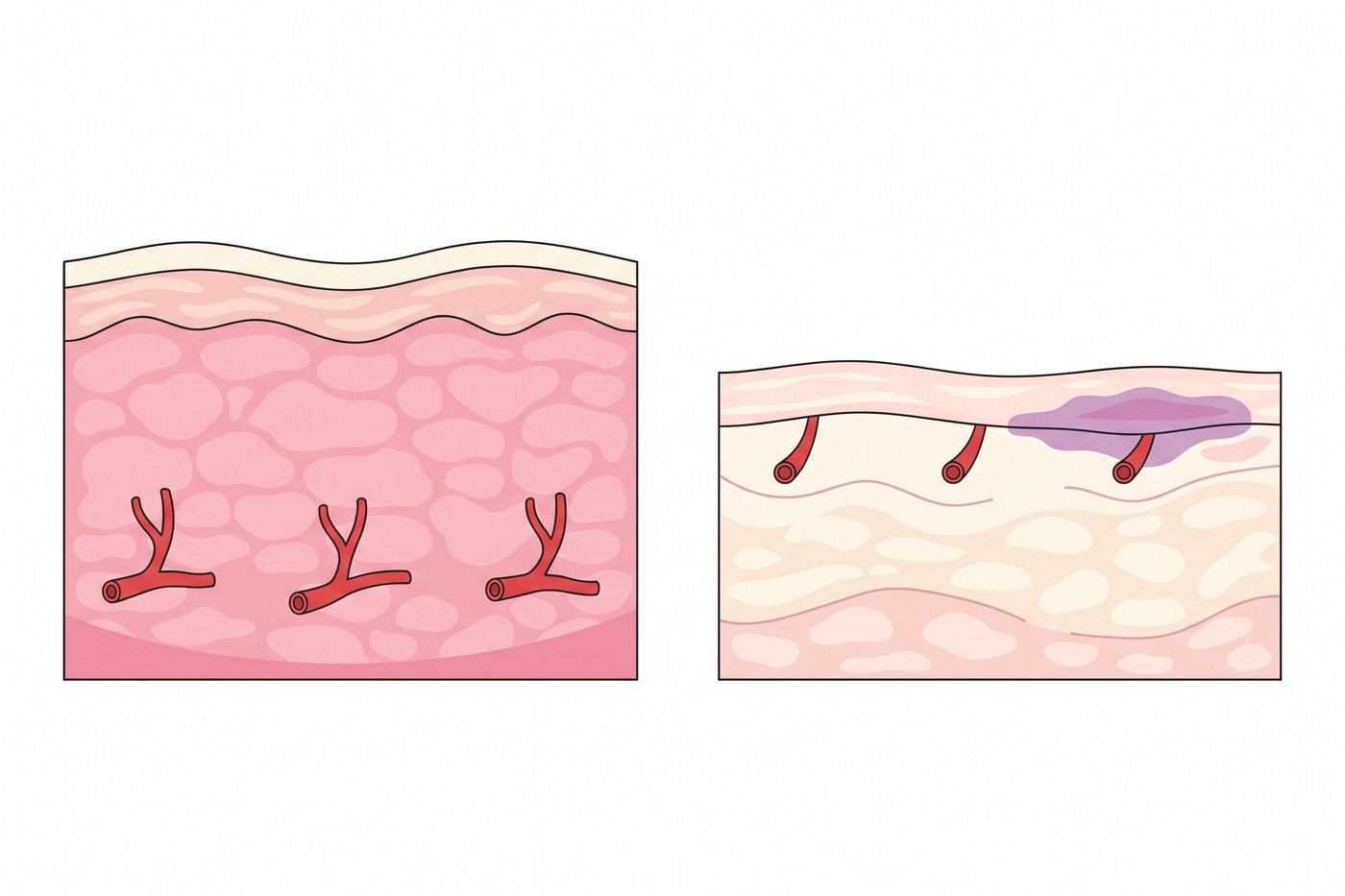
Here is the part almost nobody explains, and it takes two minutes.
Under the surface of your skin there is a thick layer packed with collagen. Your smallest blood vessels run through it. That layer does two jobs for them: it pads them, and it holds them in place.
Think about which skin on your body has seen the most sun in your life.
The tops of your forearms and the backs of your hands. Every summer, every drive with your arm at the window, every afternoon in the yard, for sixty years.
Sunlight breaks collagen down. Over decades, the padded layer under that skin gets thinner and thinner.
The small vessels are still there. But now they sit right under the surface, with very little around them.
So a light knock, a grocery bag handle, a watch band or a grandchild's grip is enough to break one. A little blood leaks out under the skin.
And because the skin on top is now so thin, you see all of it. A flat purple patch.
That is the bruise you cannot explain.
I call it Sun-Thinned Skin. Doctors call the marks actinic purpura, or solar purpura.
It explains everything you have noticed.
Why it is only your forearms and hands: that is the skin the sun reached. Why it does not hurt: nothing deep was injured, a surface vessel leaked. Why it lasts for weeks: thin skin clears leaked blood slowly. Why the skin there tears so easily: it is the same thin layer.
None of that is clumsiness. It is skin that was thinned by the sun, with the vessels under it left unprotected.
WHY "IT'S JUST AGE" NEVER FELT LIKE AN ANSWER

When I finally raised my own arms with a doctor, I got the answer I had been giving for years.
"It's very common. It's harmless. There's nothing to do for it."
It is common. Most people over 65 have some of it.
It is not dangerous in itself. I am not going to tell you otherwise.
But "nothing to do" was said about the bruise, not about the skin. Nobody in that room talked about the thin skin over my forearms, and that is where the whole thing starts.
So most women end up where I did. Back in the bathroom, going through the drawer.
WHY NOTHING IN YOUR BATHROOM DRAWER HAS CHANGED YOUR ARMS

You have tried things. Everybody has.
- Ordinary body lotion. It softens the surface for a few hours. It was never made for marks.
- A bruise gel dabbed on one mark. It goes on the bruise you can see. The thin skin an inch away, where the next one will come, gets nothing.
- Body make-up and concealer. It covers one patch for one afternoon and comes off on your sleeve.
- Long sleeves and arm covers. They hide your arms. Hiding is all they do.
- "Just be more careful." You cannot go through the day without touching a cabinet.
For anything to make a real difference to arms like ours, it has to do THREE things:
HELP THE LOOK OF THE MARKS FADE: the purple ones you have now, and the brown stains they leave behind.
CARE FOR THE THIN SKIN ITSELF: keep it hydrated and supported so it looks and feels thicker and more resilient, across the whole forearm and the back of the hand.
BE GENTLE ENOUGH TO USE EVERY DAY: on fragile skin, over the whole area, not as a dab on one spot.
Miss any ONE of those and you have another half-used tube in the drawer.
Two ingredients have been used in creams made for the look of bruising for a very long time: arnica and vitamin K.
The difference is not the ingredient. It is where you put it and how often. A dab on one bruise treats one bruise. A daily cream massaged into the whole forearm cares for the skin the bruises come from.
So the answer was never another gel for one mark. It was a daily cream for thin, fragile skin, with arnica and vitamin K in it.
INTRODUCING THICORA ARNICA & VITAMIN K CREAM

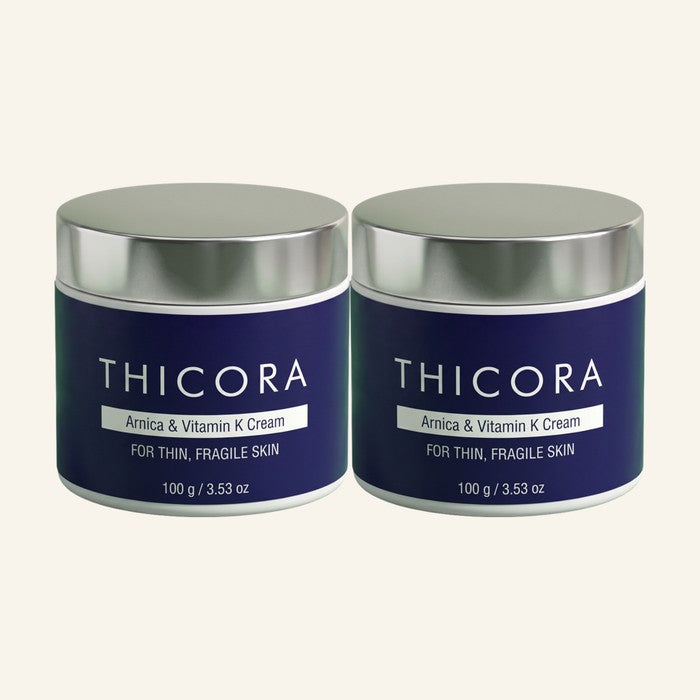
Thicora is a rich, pale-yellow cream in a 100 gram jar.
You wash and dry your arms, take some on your fingertips, and massage it in until it is absorbed. That is the whole routine.
✓ ARNICA AND VITAMIN K: the two ingredients long used for the look of bruising, together in one cream. It helps fade the look of the purple marks you have.
✓ MADE FOR FRAGILE SKIN: it supports thin, delicate skin and helps maintain the skin's integrity, so your forearms look and feel more resilient.
✓ SOOTHES AND HYDRATES: it helps the skin hold its moisture and eases dryness, which thin skin loses fastest.
✓ GENTLE ENOUGH FOR EVERY DAY: formulated to be gentle and non-irritating for daily use.
✓ SMOOTH AND SILKY: it massages in. No sticky film on your sleeves.
✓ A FULL 100 GRAM JAR: enough to do both forearms and both hands, not one spot.
You use it at home, on the whole area, including the place the next mark was going to be.
No more dabbing one bruise.
No more make-up on your arms.
No more sleeves in July.
WHAT WOMEN NOTICE

Here is what women describe, in the order they describe it.
First: the feel changes. The dry, papery surface feels softer and smoother under your hand.
Then: the marks you have look fainter. The purple softens, and the brown shadows left by old ones look lighter.
Then: your arms look more even. Fewer dark patches catch your eye when you reach for something.
After that: the skin looks and feels more resilient. Well-hydrated, cared-for skin looks fuller than dry, neglected skin.
Individual experience varies, and the women below are describing theirs.
WHAT WOMEN ARE SAYING


"For years I was told it was just age. The purple patches on my forearms look so much fainter, and my arms feel like skin again when I run my hand down them. I'm 74 and I wore short sleeves to church on Sunday."
"Nobody ever told me it was the sun and the thin skin. I thought I was clumsy. Doing my whole forearm every day made more sense than chasing one bruise at a time."
"The backs of my hands were the part I hid. They look smoother and more even now, and I have stopped putting them in my lap at the checkout."
"It is silky and it goes right in. My arms feel softer and stronger, and my daughter asked what I had changed."
WHAT THE BRUISED FOREARMS HAVE ALREADY COST YOU

Let me lay out the usual routes, because I watched women take all three.
The Cover-Up Route:
- Long sleeves through every summer
- Arm covers and body make-up
- The short-sleeved tops that have not left the closet
The Drawer Route:
- Lotions, gels and creams bought one at a time
- A dab on each new bruise
- Another tube that changed nothing
The "Be Careful" Route:
- Flinching when a grandchild grabs your arm
- Explaining to strangers that nobody hurt you
- Thinking twice before you garden or carry the groceries
The regular price for two jars of Thicora is $138.
But that is not what you will pay today.
WHY WE SEND TWO JARS, AND CHARGE FOR ONE
This is a cream for the whole area, every day: both forearms and the backs of both hands. Not a dab on one mark.
So every order on this page is at least two jars. Buy one jar, and the second is free.
Today that is $69 for two jars. $34.50 a jar.
- Less than the arm covers and long sleeves you have bought.
- Less than the creams already in your drawer.
- Less than the summer tops you have stopped wearing.
For something you use at home, on the skin where the bruises start.
LOOK, I UNDERSTAND THE SKEPTICISM
You have been told there is nothing to do. You have a drawer that agrees.
So here is my promise, and it is the only promise on this page:
Use it for 90 days. If you do not like what you see and feel on your own arms, email us and we refund every penny.
- No forms.
- No "store credit".
- No sending anything back.
Why am I comfortable making that offer? Because you do not need me to tell you whether you like it. You look at your own arms every day.
Support: support@thicora.com
BUT HERE'S THE CATCH
The buy-one-get-one pricing on this page is our Early Black Friday price for readers of this article, and it ends at midnight.
We do not sell on Amazon or in drugstores.
If you are reading this, the two-jar pricing is still available.
At midnight it goes back to the regular price.
And here is the thing...
Every month you wait is another month:
- The skin on your forearms goes without care
- A new mark arrives before the last one has faded
- You choose your clothes by what covers your arms
While a daily cream made for thin, fragile skin costs $34.50 a jar.
THE CHOICE THAT DECIDES WHAT YOUR ARMS LOOK LIKE NEXT SUMMER
Right now, you are at a fork.
Path #1: Keep Covering Them
Keep the long sleeves. Keep dabbing at one bruise. Keep blaming yourself for being clumsy. Keep hearing "that's just age".
Path #2: Care For The Skin The Bruises Come From
Spend less than you already have on sleeves and arm covers, get two jars, massage it into both forearms and both hands every day, and look at your own arms in a few weeks.
The choice seems pretty obvious to me.
HERE'S EXACTLY WHAT TO DO NEXT
- 1. Click the button below that says "Check Availability Now →"
- 2. Choose your pack. (Two jars is where most women start.)
- 3. Fill in your shipping details. Shipping in the US is free.
- 4. When it arrives, wash and dry your arms, apply the cream to your forearms and the backs of your hands, and massage until it is absorbed. Keep it away from your eyes and any broken skin.
- 5. In a few weeks, hold your arms out in the daylight. Then email us and tell us what you saw. We read every one.
But whatever you do, don't close this page thinking "I'll order later."
Later is another summer in a cardigan.
Later is another stranger asking what happened to your arm.
Later is the two-jar pricing being gone.
You were never clumsy. The sun thinned the skin on your forearms, and nobody told you.
Click below and see the difference on your own arms.
EARLY BLACK FRIDAY READER OFFER
UNTIL MIDNIGHT:
BUY ONE JAR, GET ONE JAR FREE + FREE US SHIPPING
EARLY BLACK FRIDAY READER-ONLY SPECIAL:
Ordering from this page gets you two jars for $69, free US shipping, and the 90-day money-back promise above.
From one woman who has it to another,
Diane Hollis, RN
Wound Care Nurse (retired)
P.S. I wore a short-sleeved dress to my granddaughter's graduation in May. First time in four years.
P.P.S. If your bruising came on suddenly, is spreading, or shows up in places the sun never reached, see your doctor first. And keep taking exactly what you have been prescribed.
P.P.P.S. The two-jar Early Black Friday pricing ends at midnight. The button below is the only place it exists.